
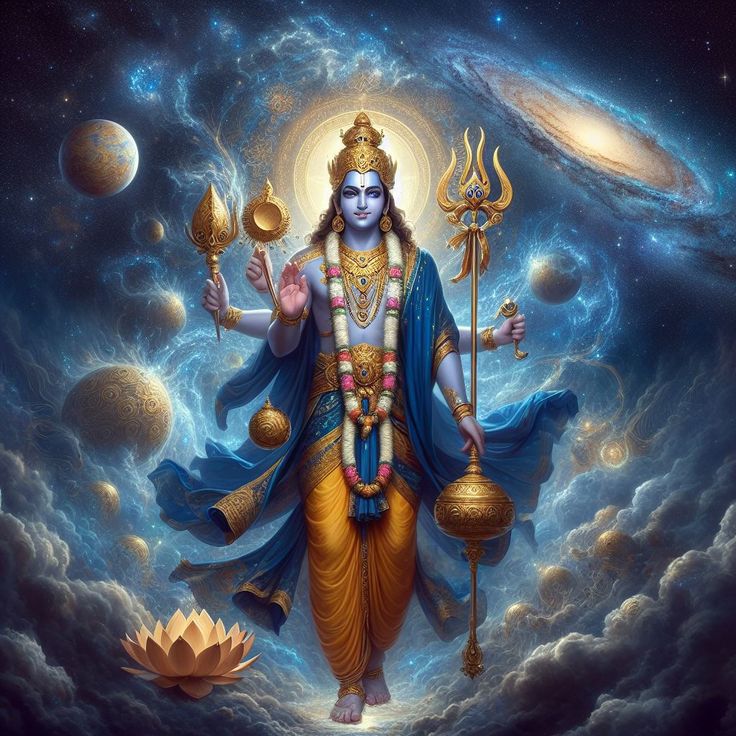
Vishnu
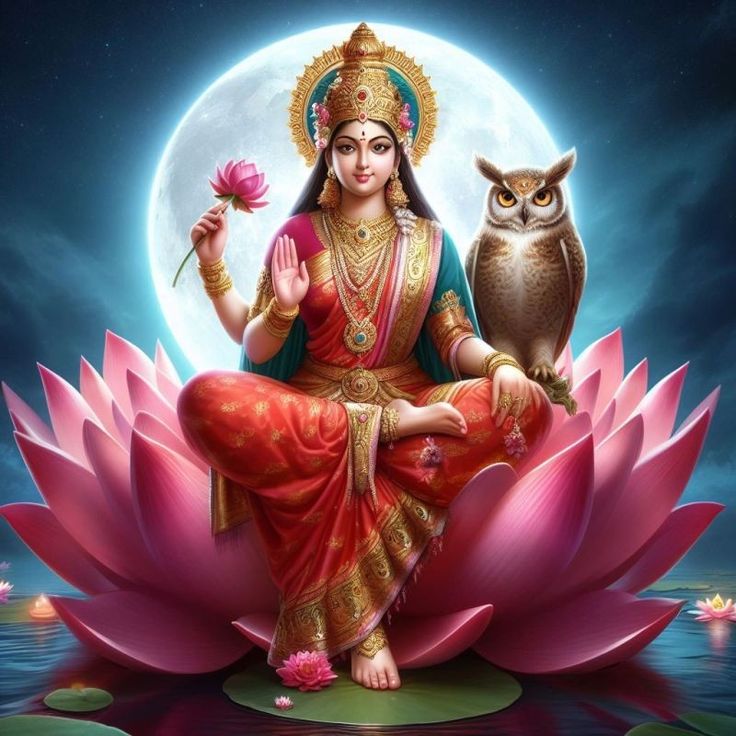
Lakshmi
Lakshmi Mata Lakshmi is one of the principal Goddesses in Indian mythology. She is the daughter of Maa Durga and the consort of Lord Vishnu. She is known as the Goddess of wealth, fortune, prosperity, beauty and fertility. Whenever Lord Vishnu descended the Earth with one of his avataars, he was accompanied by an avataar of Goddess Lakshmi. Along with Goddesses Parvati and Saraswati, she forms the holy Tridevi of Hindu Goddesses. Lakshmi’s name is derived from the Sanskrit word ‘lakshya’, which means ‘aim’ or ‘goal’. Goddess Lakshmi is usually depicted as a beautiful and elegant woman of golden complexion, with four hands, sitting or standing on a full-bloomed lotus and holding a lotus. She is adorned with a lotus garland and has white elephants by her side. When she is shown along with Lord Vishnu, she is shown with two hands. Goddess Lakshmi’s birth legend starts with the meeting between Lord Indra and Sage Durvasa. When Lord Indra had come to meet the sage, he was welcomed and showered with flowers and garland. Lord Indra put the garland on his elephant- Airavat’s head which the elephant threw down. Enraged at this, he cursed Lord Indra due to which the heaven as well as earth started collapsing. Gods started losing their energy, humans started becoming greedy and due to this the demons invaded and captured the two worlds. The Gods rushed to Lord Vishnu for help who suggested the churning of the ocean to restore back the power to the Gods by drinking the immortal Amrit. This is how the churning of the ocean- Samudra Manthan started which was a tug of war between the demons and the Gods. During the churning of the ocean, emerged Goddess Lakshmi on a full-blown Lotus. The Gods drank the Amrit and defeated the demons and got their heaven- Swarg and Earth and restored peace and order in the Universe. It is also believed that Lord Vishnu who was present during the Samudra Manthan was impressed with the beauty of Goddess Lakshmi an asked her to marry him. The Goddess agreed immediately and married him. It is also said that Goddess Lakshmi resides in the houses of people who have a good heart. In many villages and cities, it is said that Goddess Lakshmi is born when a girl-child is born in that house. Devotees in India worship Goddess Lakshmi for her to grant wealth and success. During the festival of Diwali, devotees pay a tribute to Goddess Lakshmi by cleaning their homes, lighting lamps, doing rangoli, and doing Lakshmi Pooja and invite her to their homes to bless them with abundance, good luck, and prosperity. Hindu Mythology Kaali Hindu Mythology Brahma Hindu Mythology Saraswati Hindu Mythology Vishnu Hindu Mythology Lakshmi Hindu Mythology Shiva Hindu Mythology Parvati Hindu Mythology Ganesha Hindu Mythology Durga Hindu Mythology Indra Hindu Mythology Rama Hindu Mythology Sita Hindu Mythology Hanuman Hindu Mythology Krishna Hindu Mythology Buddha Previous Next
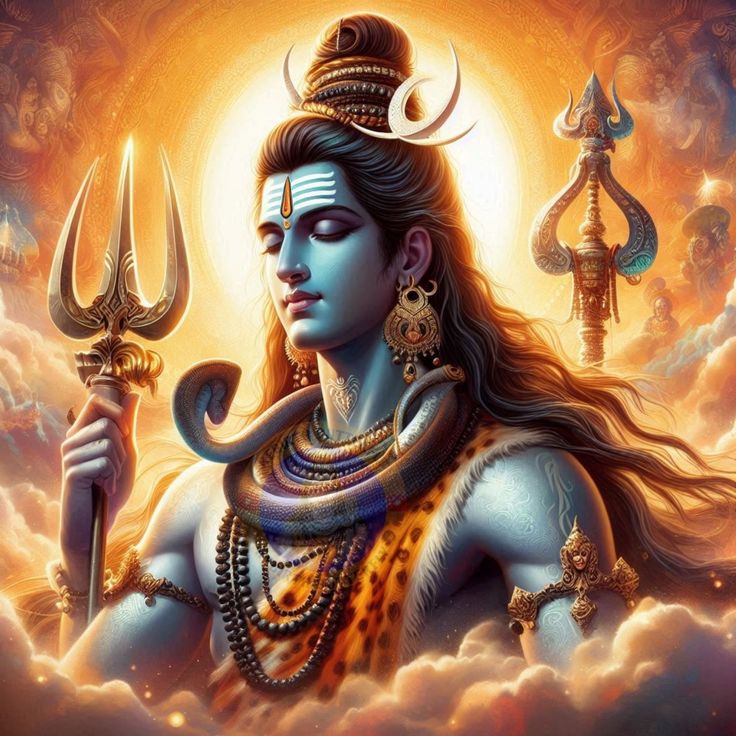
Shiva
Shiva Lord Shiva is one of the 3 main Gods in Indian mythology and is one of the most powerful gods in the Hindu pantheon. He is a part of the holy trinity, along with Lord Brahma and Lord Vishnu. He is known as the destroyer because he removes all the evil from the world. He is also considered to be a master of dance and regeneration. He is also known as the master of yoga and meditation. Shiva is known by many names. Some of them include Mahadeva, Adiyogi, Pashupati Nath, Nataraja, and Bhole Nath. In his Mahamritunjay avataar, he is said to be the conqueror of death. His Ardhanarishwar avataar is the best demonstration of half Shiva (the male) and half Shakti (the female). Lord Shiva is often depicted with his hair piled high on top of his head with a crescent tucked into it. The river Ganga, which is a heavenly river, originates from his matted hair. When Ganga started flowing on earth, she did not know how to control her flow and energy and if the speed and momentum would have remained, she would have drowned the earth. Hence Lord Shiva had to tie her around his hair so that the earth would not get flooded and she got to gently descend down from the Himalayas. This is how Shiva got the name Gangadhar. Because of his matted hair, he is also known as Jatadhatri Shiva. Lord Shiva holds a trident in his left hand and holds a ‘damroo’ (power drum) in his right hand. He wears the Rudraksha beads which is his favourite ornament and his whole body is smeared with ash. Rudraksha is also called as Shiva’s tears. Lord Shiva has a blue neck because according to one legend, he swallowed poison to save everyone in the universe. It is said that the poison was so powerful that only Shiva was able to consume it and nullify its harmful effect. Because of the blue throat, he is known as Neelkantha (neel means blue and kantha means throat). The serpent Vasuki is coiled around Lord Shiva’s neck. Lord Shiva has a third eye on his forehead and when he opens his third eye, he becomes the fiercest and everything gets burnt and turns into ashes. It is also believed that Lord Shiva’s weapon which is the Trishul was created by the master craftsman called Vishwakarma using the material from the Sun. Lord Shiva resides in Mount Kailash on the Himalayas and is known as Adiyogi which means the first yogi. His wife is Goddess Parvati and Lord Ganesha and Lord Kartikeya are his sons. Lord Shiva is usually worshipped in the form of a linga. You will always find Lord Nandi (the bull) in every Shiva temple. There is a famous legend which talks of how at the start when the Universe was created, there was a huge pillar off endless light and energy which was the “linga” and it is said that the linga is a symbolic manifestation of Lord Shiva as his energy is also without any bounds and is infinite. The famous legend of how Lord Shiva chopped off Lord Ganesha’s neck is a story that is told to every child. While protecting and obeying his mother, Goddess Parvati’s instructions, Lord Ganesha did not allow anyone, including Lord Shiva to enter the bathing area where his mother was taking bath. This enraged Lord Shiva who did not know that Parvati had created Ganesha with her own maya and hence he was their son. In a fit of rage, Lord Shiva chopped off Ganesha’s neck with his trident. Once Parvati realized what had happened, she forced Shiva to bring back Ganesha to life and for that Shiva fixed the head of an elephant and brought back the obedient son to life. All the Gods then blessed Ganesha in his new avataar. Hindu Mythology Kaali Hindu Mythology Brahma Hindu Mythology Saraswati Hindu Mythology Vishnu Hindu Mythology Lakshmi Hindu Mythology Shiva Hindu Mythology Parvati Hindu Mythology Ganesha Hindu Mythology Durga Hindu Mythology Indra Hindu Mythology Rama Hindu Mythology Sita Hindu Mythology Hanuman Hindu Mythology Krishna Hindu Mythology Buddha Previous Next
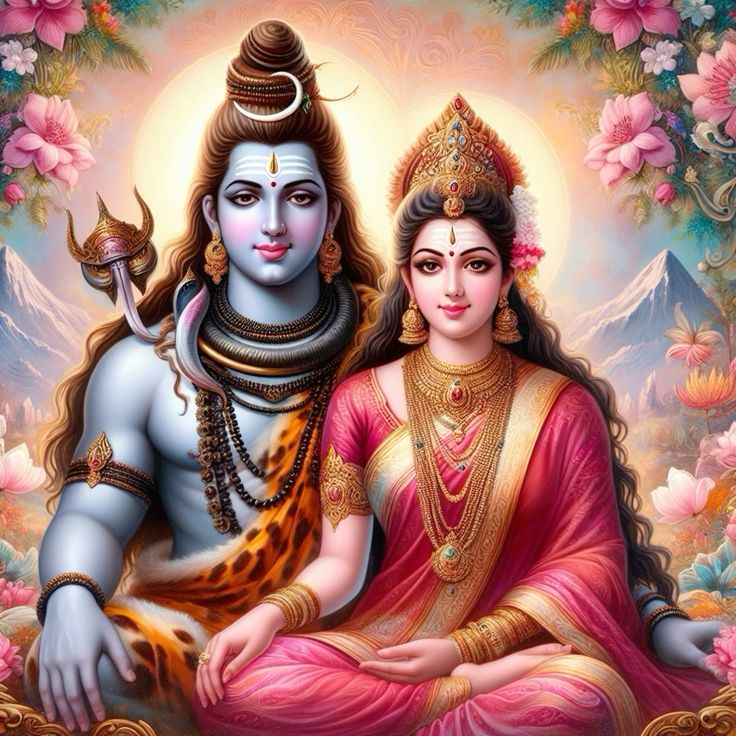
Parvati
Parvati Parvati is a benevolent Goddess of beauty, marriage, and fertility. She is also called Shakti and mother of the Universe. She is the daughter of Himalaya, the Lord of the mountains and wife of Lord Shiva. She won Lord Shiva’s heart through severe penance. Legend says that the Gods wanted Shiva to marry Parvati so that their first-born (Lord Kartikeya) would kill the demon Tarakasur, who was granted a boon by Lord Brahma that he would only be killed by Shiva’s son. Hence the Gods sent Parvati to Shiva who was lost in meditation. The love God, Kama Dev struck Shiva with his love arrow, but Shiva got disturbed in his meditation, and opened his third eye and burnt Kama Dev to ashes due to his anger. It is also believed that Goddess Parvati took 108 births until Lord Shiva noticed her dedication and agreed to marry her. Goddess Parvati is also said to be the reincarnation of Mata Sati, who is Lord Shiva’s first wife who immolated herself. Since her childhood, Sati loved Lord Shiva and was his ardent devotee. Despite her father, King Daksha’s unwillingness, Sati married Lord Shiva with Lord Brahma as the priest. King Daksha continued to dislike Lord Shiva and once when he conducted a Yagna (religious fire-ceremony), he invited all Gods except Lord Shiva. Sati Mata was very hurt at this rude gesture of her father and unable to bear the humiliation, she burnt herself to protest and show her anger. When Lord Shiva came to know this, he was furious and performed his destructive Tandav dance. He carried Sati Mata’s body around the world. He wanted to take Sati to Mount Kailash and all Gods knew that Lord Shiva’s anger would mean end of the world. To save the Universe, Lord Vishnu used his Sudarshan Chakra and cut Sati Mata’s body parts into 51 pieces which fell at 51 different places. These places are very sacred and of great religious significance and are called Shakti Peethas. Mata Parvati has two sons- Lord Kartikeya and Lord Ganesha. Lord Ganesha was created by performing a miraculous feat of creating a boy from her sandalwood paste and bringing him to life. Hindu Mythology Kaali Hindu Mythology Brahma Hindu Mythology Saraswati Hindu Mythology Vishnu Hindu Mythology Lakshmi Hindu Mythology Shiva Hindu Mythology Parvati Hindu Mythology Ganesha Hindu Mythology Durga Hindu Mythology Indra Hindu Mythology Rama Hindu Mythology Sita Hindu Mythology Hanuman Hindu Mythology Krishna Hindu Mythology Buddha Previous Next
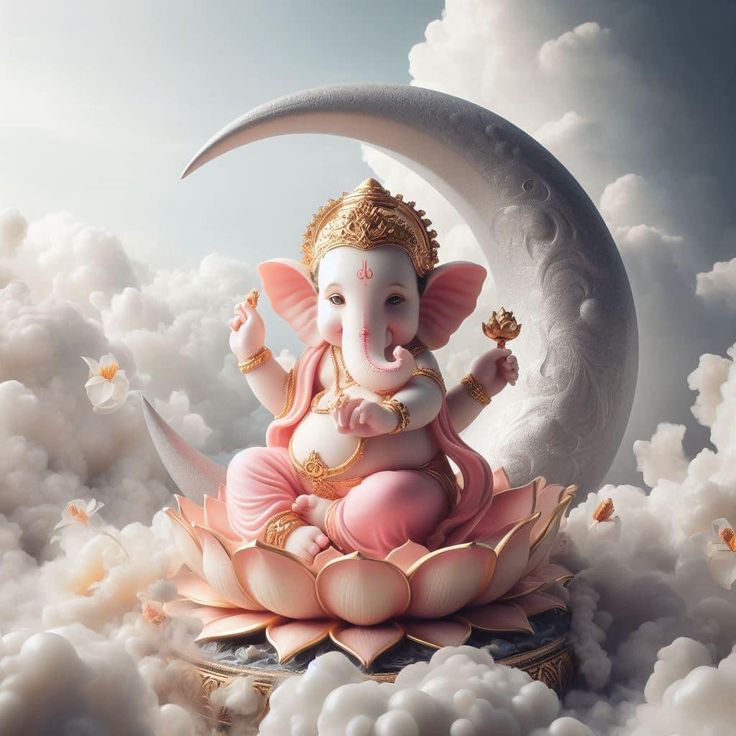
Ganesha
Ganesha The son of Shiva and Parvati, the elephant God Ganesha is the God of success and knowledge. He is one of the most prevalent deities in the Hindu pantheon. Ganesha’s large, elephantine head symbolizes the wisdom, knowledge, and good luck that he bestows upon his worshippers. His one tusk, elephant head and human body makes him a unique God. He has a big belly which symbolizes the universe, large ears as he listens to every devotee, and his vehicle who is a mouse is always seen by his side. It is said that Lord Ganesha grants good fortune to those who offer him his favourite sweet called the “Modak”. He loves the bright red hibiscus flower as it signifies prosperity. Ganesha is worshipped in every Indian household, especially at the start of any auspicious event or ceremony. There are countless mythology stories about Lord Ganesha. One interesting story is about his birth. It is believed that Goddess Parvati once while going for her bath, created a boy from a sandalwood paste and breathed life to give birth to Lord Ganesha. She then asked this boy to stand as a guard while she took her bath. Lord Shiva who was not aware that he now had a son, returned to see a boy obstructing his path and not letting him enter. This angered Lord Shiva who chopped off the boy’s head. When Goddess Parvati came out, she was shocked and angry to see her headless son. She told Lord Shiva that she would destroy the entire world if her son was not brought back to life. Shiva then asked his most faithful, Nandi bull to go to the forest and bring the head of first animal that he could sight. Nandi came with an elephant head, which was then joined to the body of his headless son. This is how Ganapati or Ganesha was born. Siva also gave him a boon that he will always be the first one to be worshipped by people before any beginning. Like his elephant head, there is also an interesting myth associated with Lord Ganesha’s broken tusk. The great Sage Vyas, who is the author of the Mahabharata epic, wanted to write the Mahabharata. He requested Lord Ganesha to be his scribe. Lord Ganesha agreed but told Sage Vyas that he should not stop dictating till everything is complete. While the epic was being written, the feather which was used for writing broke. So, Lord Ganesha quickly broke his tusk, dipped it in ink and continued writing till the end. This is how he has one tusk. There is another extremely interesting mythological story associated with Lord Ganesha. Ganesha loved modak and laddoos. One day, he ate a lot of sweets that were offered to him and his belly was full. When he sat on his vehicle which was the tiny mouse, due to Lord Ganesha’s weight, the mouse tripped and Ganesha fell along with his sweets. The moon saw this and started laughing. He was very proud of his good looks and laughed at Ganesha’s big belly. Ganesha got furious at the Moon’s vanity and cursed him that anyone who looks at the moon will be wrongly blamed. That way, the Moon realised that no one would ever look at him. He begged to Lord Ganesha who then made it mild and said anyone who looked at the moon on the day of Ganesh Chathurthi could also redeem themselves by looking at the moon on the second day and listening to stories of Krishna. Hindu Mythology Kaali Hindu Mythology Brahma Hindu Mythology Saraswati Hindu Mythology Vishnu Hindu Mythology Lakshmi Hindu Mythology Shiva Hindu Mythology Parvati Hindu Mythology Ganesha Hindu Mythology Durga Hindu Mythology Indra Hindu Mythology Rama Hindu Mythology Sita Hindu Mythology Hanuman Hindu Mythology Krishna Hindu Mythology Buddha Previous Next

Durga
Durga Maa Durga is the mother goddess and represents the powers of all Gods. She is the protector of the righteous and the destroyer of evil. She is associated with protection, strength, and wars. Her legends are mostly around destroying demons. Goddess Durga is usually pictured as a beautiful woman and multi-limbed so that she may always be ready to battle evil from any direction. She carries a variety of weapons and other items that she uses in her fight against evil. Each of the weapons are special and are gifted to her by Gods. She is frequently depicted riding a lion, which represents power, will, and determination. According to legends, Goddess Durga was created by the holy Trinity- Brahma, Vishnu and Mahesh to slay the buffalo demon – Mahishasura. She is the collective energy and Shakti of the Holy Trinity and her creation also has some contribution by the other Gods. It is believed that all Gods gave Durga her body form when she arose from the Ganga River in a spirit form. Lord Shiva gave her the face, Lord Indra built her torso, Lord Brahma crafted her teeth and Lord Agni built her eyes. Many Gods gave her their weapons. This is how the great force to fight the demon Mahishasura was born. Mahishasura was the ruler of the underworld called Pataal-lok which is the home of the demons. He was strong and greedy and wanted to conquer the Swarglok (where the Gods and Goddesses resided) and Bhumi-lok (earth where humans lived). The demon Mahishasura had done penance to win Lord Brahma’s blessing. As a reward for his hard work, he asked the Lord to grant him the boon of immortality. But the Lord told him that it is the rule of the cosmos that who is born has to die. So Lord Brahma asked him to choose how he would like to die. That’s when Mahishasura said that he wished to be killed at the hands of a woman as he thought no woman could match his strength and hence indirectly he would continue to remain immortal. With this boon, he became even more evil and started causing chaos in the Universe. To bring an end to his misdeeds was the reason to create Maa Durga to vanquish the demon. Lord Shiva handed over his Trishul, Lord Vishnu gave her a disc, Lord Indra gave his lightning rod and other Gods gave their other special weapons along with a ferocious lion. In a huge fight between Maa Durga and the demon, the Goddess killed him and emerged victorious. Hence, she is called the Invincible Goddess. Hindu Mythology Kaali Hindu Mythology Brahma Hindu Mythology Saraswati Hindu Mythology Vishnu Hindu Mythology Lakshmi Hindu Mythology Shiva Hindu Mythology Parvati Hindu Mythology Ganesha Hindu Mythology Durga Hindu Mythology Indra Hindu Mythology Rama Hindu Mythology Sita Hindu Mythology Hanuman Hindu Mythology Krishna Hindu Mythology Buddha Previous Next
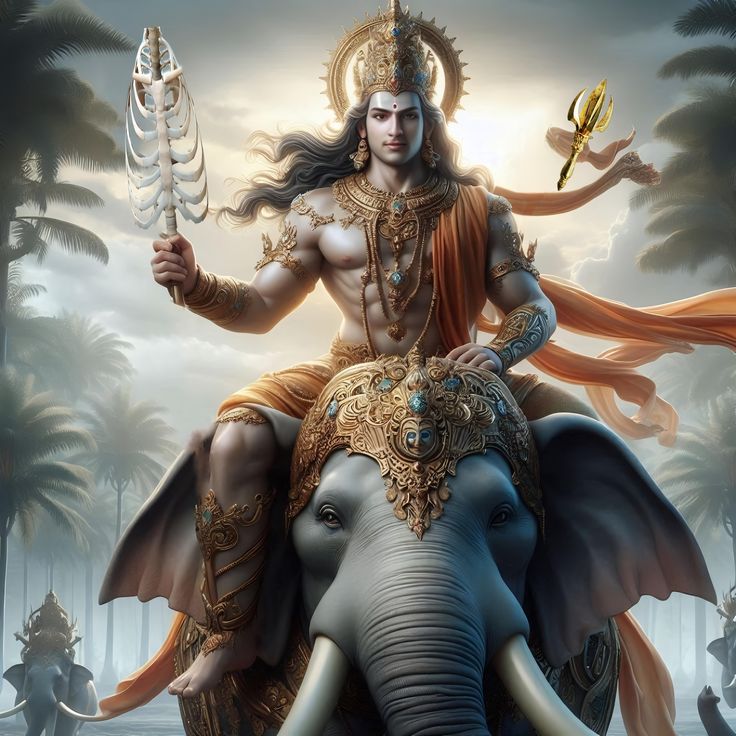
Indra
Indra Lord Indra is the King of the Gods (Devas) and ruler of Swarg-lok (Heaven). His capital city, Amaravati is called the immortal city and he resides on Mount Meru. He is the God of thunder, lightning, rains, storms and weather. He is Lord Agni’s (God of fire) brother. In India, there are no temples to worship Lord Indra. Lord Indra is fond of the Somras and considered that as his refreshing brew. His vehicle is the majestic white elephant called Airavat. His weapon is very powerful and is called Vajra which was made from Sage Dadichi’s bones so that they act like a strong rock. Lord Indra is married to Sachi who is also called Indrani. Legends say that the beautiful and elegant Sachi was emperor Pauloma’s daughter. One of his commanders-in- chief, Vrut was in deeply in love with Sachi Devi but she rejected his proposal as he was not a king. A dejected Vrut did penance of Lord Shiva who was pleased with his devotion and granted him a wish. Vrut asked for the immortality boon and said that he should not be killed with any weapons. When the boon was granted, he marched to Pauloma’s kingdom and conquered it. He became a demon Vritrasura and started even causing havoc among all Gods and defeating them and swallowing their weapons so that he could not be killed by any human or any God. He stole all the water from the Universe and also threw the Gods out of heaven. When Indra came to fight the demon, the fight continued for many days and many nights. Eventually, Vritrasura swallowed Lord Indra. Vritrasura could not be killed by normal methods and hence the Vajra weapon was specifically designed from Sage Dadhichi’s bones. Using the Vajra weapon, Lord Indra tore open Vritrasura’s stomach and released all the water and peace back to the Universe. The Gods then safely returned to heaven. Indra, who had fallen in love with Sachi, asked for her hand and then married her. Hindu Mythology Kaali Hindu Mythology Brahma Hindu Mythology Saraswati Hindu Mythology Vishnu Hindu Mythology Lakshmi Hindu Mythology Shiva Hindu Mythology Parvati Hindu Mythology Ganesha Hindu Mythology Durga Hindu Mythology Indra Hindu Mythology Rama Hindu Mythology Sita Hindu Mythology Hanuman Hindu Mythology Krishna Hindu Mythology Buddha Previous Next
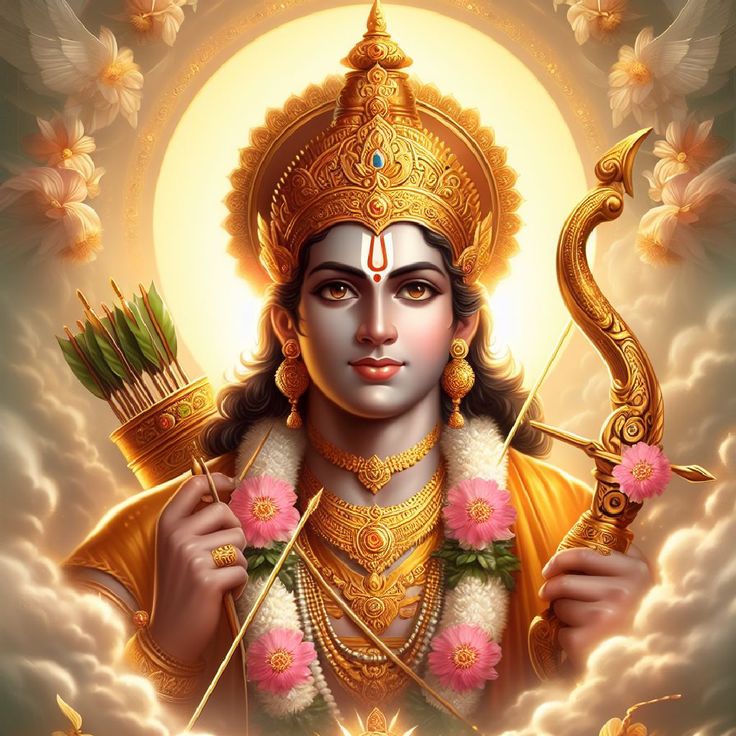
Rama
Rama Lord Rama is the seventh and the most popular avataar of Lord Vishnu. He is known as the ideal man and ideal son. The epic Ramayana, which is composed by the great Sage Valmiki has all stories around his life. Lord Rama is shown as a standing figure, holding an arrow in his right hand and a bow in his left hand. His idols are usually accompanied by his wife, Sita Mata and his favourite brother, Lakshman and his favourite devotee, Lord Hanuman. Rama is the son of King Dasharatha and Kaushalya and is from Ayodhya. King Dasharatha had three wives and four children- Rama, Lakshman, Bharat and Shatrugan. While all the four sons were dear to King Dasharatha, Rama was his favourite. Sita, his wife is also known as the ideal wife. Mythological stories say that Lord Shiva had granted a boon to a very powerful demon king Ravana that he will be invincible and cannot die at the hands of Gods. He also had the boon of 10 heads and was the ruler of the Golden Lanka which was an extremely rich land. Hence the Gods went to Lord Brahma to seek a solution from Ravana’s menace. Lord Vishnu himself appeared and said he will take birth as Rama and kill Ravana. Rama was sent to exile by his father, King Dasharatha and stepmother, Kaikeyi for 14 years. He was accompanied by his wife, Sita and his brother, Lakshman. Queen Kaikeyi wanted her son, Bharat to be the King after her husband and hence made the plot. For 14 years, the exile continued in Panchavati which is present day Nashik city in Maharashtra, India. It is also believed that Lakshman did not sleep for all the 14 years of the exile to protect his sister-in-law and brother. He had requested Goddess of sleep, Nindra give him the blessing to stay awake for the 14 years. While the Goddess granted him the boon, she said that someone else had to sleep for these 14 years as a balancing act. Urmila who was Lakshman’s wife readily agreed and slept for these 14 years and sacrificed her life in the precious years. During the exile, Sita was kidnapped by Ravana who wanted to make her his wife. Rama along with his monkey army fought Ravana and his demon army and rescued Sita. After completing his exile, when Lord Rama returned to Ayodhya, he ruled the kingdom and this golden period was called “Ram Rajya”. The festival of Ram Navami is a festival to celebrate the virtues and ideal path of living as demonstrated by Lord Rama. Hindu Mythology Kaali Hindu Mythology Brahma Hindu Mythology Saraswati Hindu Mythology Vishnu Hindu Mythology Lakshmi Hindu Mythology Shiva Hindu Mythology Parvati Hindu Mythology Ganesha Hindu Mythology Durga Hindu Mythology Indra Hindu Mythology Rama Hindu Mythology Sita Hindu Mythology Hanuman Hindu Mythology Krishna Hindu Mythology Buddha Previous Next
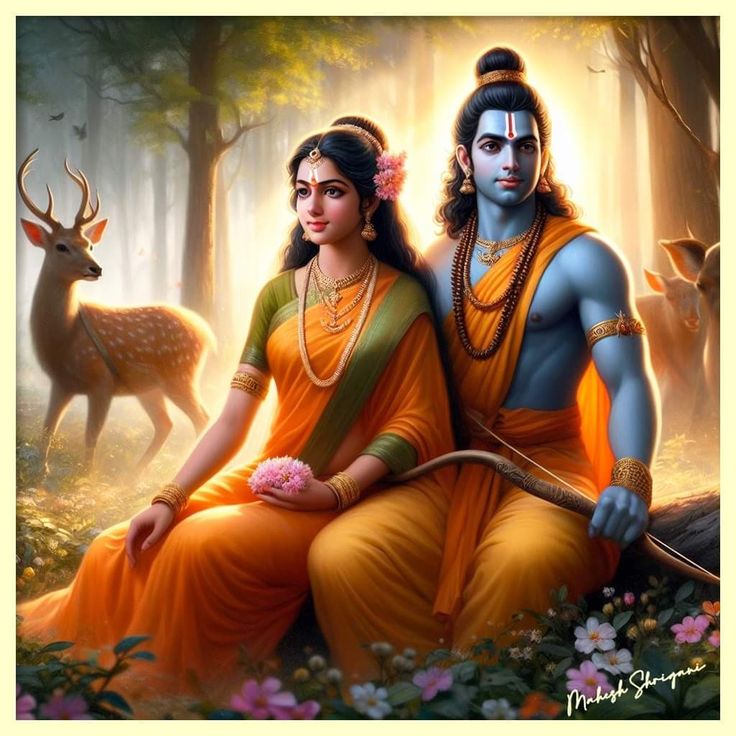
Sita
Sita Goddess Sita is revered for her purity, dedication and sacrifice. She is Lord Rama’s wife and is considered to be Goddess Lakshmi’s form. She is the adopted daughter of King Janak, who was the ruler of Mithila. Sita is the daughter of Mother Earth. She was found on the land when King Janak was ploughing his field and hence is also called as the daughter of Bhoomi (earth). As a child, Sita was very strong and is said to have lifted the table on which Lord Shiva’s bow was kept. Due to this incident, King Janak had kept a competition during Sita’s Swayamvar (wedding), that Sita would marry only that person who would lift Shiva’s bow. This feat was performed by Prince Rama and hence he was selected as Sita’s lucky groom. The epic Ramayana is not only about the stories of Lord Rama but also called “Sita Charitra” as she is the Lord Rama’s strength. She is known as the ideal daughter, ideal wife and ideal mother to her twins- Luv and Kush. She was Lord Rama’s silent pillar of strength and support especially during his years of exile. When Lord Rama was banished for 14 years, she voluntarily accompanied her husband and happily wanted to support him in the tough phase of life, despite living a life of luxury. In the forest of Panchavati, where they were staying during the exile, one day, Sita Mata spotted a Golden Deer who was actually the demon called Mareecha, who was Ravana’s uncle. On Sita’s insistence, Rama followed the golden deer deep into the forest and realised it was a ploy only after he killed the deer who then returned to its natural demonic form. Until then, Ravana had very cleverly disguised himself as a Sage and went to ask Sita for alms who innocently crossed the line, Lakshman had drawn to protect Sita from evil. Ravana kidnapped Sita and held her hostage in Ashokavan in Lanka and forced her to marry him. She was kept in captivity for one year, but she did not yield to Ravana’s pressure and continued to love Lord Rama who along-with his monkey army, his loyal devotee Lord Hanuman and Lakshman rescued her. After a huge battle between Rama and Ravana, Rama emerged victorious and rescued Sita. But Sita Mata had to undergo lot of trials by the people after being rescued by Lord Rama from the evil Ravana. She went through Agni Pariksha (trial by fire) and it is because of her courage that she emerged as the final winner. Some myths say that when Sita Mata gave Agni Pariksha, the coals on the fire automatically turned into soft lotus as soon as she stepped on them. This is how she remains the eternal representation of purity and divinity. Hindu Mythology Kaali Hindu Mythology Brahma Hindu Mythology Saraswati Hindu Mythology Vishnu Hindu Mythology Lakshmi Hindu Mythology Shiva Hindu Mythology Parvati Hindu Mythology Ganesha Hindu Mythology Durga Hindu Mythology Indra Hindu Mythology Rama Hindu Mythology Sita Hindu Mythology Hanuman Hindu Mythology Krishna Hindu Mythology Buddha Previous Next
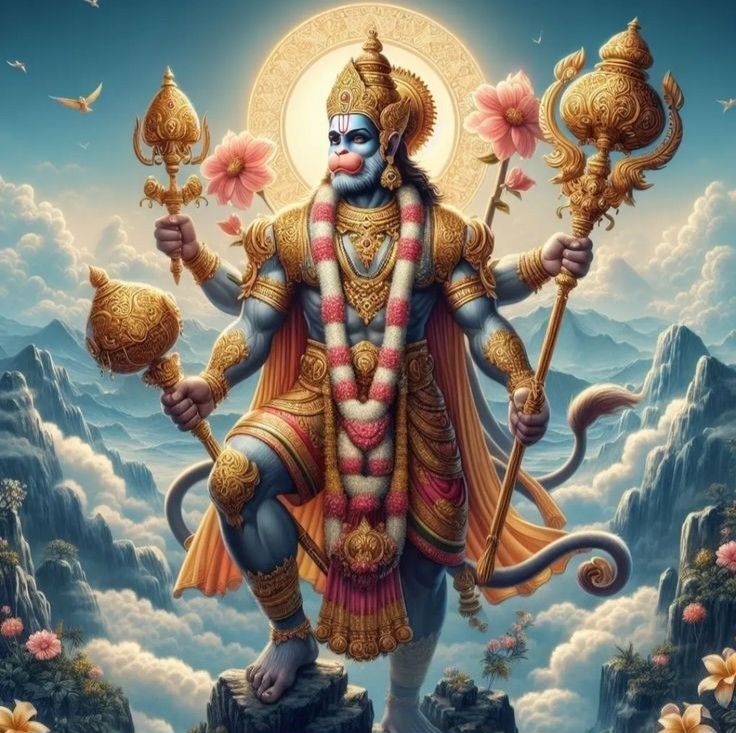
Hanuman
Hanuman Lord Hanuman is the Monkey God renowned for his courage, power, strength, self-discipline and devotion. He is believed to remove all obstacles in life and protects all his devotees. He is half-monkey and half-human. Some say Hanuman was born as the son of the King Kesari who is the King of the monkeys and Queen Anjana, a female Apsara who had been transformed into a monkey by a curse. Both of them performed penance for 12 years and Lord Shiva granted them a child, Hanuman as a boon. Hence it is believed that Lord Hanuman is a reflection of Lord Shiva. He is fondly called Bajarangabali or Maruti by his devotees. Another legend mentions that Lord Hanuman is the son of Anjana and Vayu Dev, the wind god. The myth says that Vayu Dev delivered a sacred pudding to Anjana while she was praying to Lord Shiva, who steered Vayu Dev’s energy to Anjana’s womb. Hence Vayu Dev is known to be Hanuman’s spiritual father and Lord Hanuman is also addressed as Vayuputra (Vayu means wind and putra means son). Lord Hanuman received the ability to fly from Vayu Dev. As a child, Hanuman was very adventurous. One day, he mistook the Sun to be a ripe yellow mango and jumped at it to eat it. On the way, he met Rahu, a planet who was pursuing the Sun for an eclipse, but Lord Hanuman thrashed Rahu so he could eat his mango. Lord Indra saw this and got angry and stuck Hanuman with his thunderbolt. Hanuman fell on the ground in an unconscious state and the thunderbolt damaged his chin permanently. Seeing his son hurt, Vayu Dev got furious and sucked all the air from the Universe making humans, animals, birds to struggle for breath. Lord Indra withdrew his thunderbolt and all the Gods and Goddesses blessed Hanuman with multiple boons. This pacified Vayu Dev and he resumed the Universe to normal life. The thunderbolt is the reason for the round jaws of Lord Hanuman. Lord Hanuman is one of the key characters in the Ramayana and was the greatest devotee of Lord Rama. Once he saw Sita Mata apply vermilion on her forehead. He asked her why she was doing so. Sita Mata replied that she was applying vermilion to ensure a long life for Lord Rama. As soon as he heard this, Lord Hanuman applied the vermilion to his entire body. Lord Rama was pleased with the devotion and love and blessed him that people will fondly call him Bajrangbali (bajrang means orange). In Ramayana, there is one interesting story where Hanuman goes to visit Sita Mata in Lanka and give the good news to her that Lord Rama is coming to Lanka with his army to rescue her. He gets caught by Meghnad who was Ravana’s brave warrior son, while Hanuman was leaving Lanka. Meghnad had to use the powerful Brahmastra weapon to catch Hanuman. Ravana’s guards bring him to the main hall where Ravana questions him and speaks negative of Lord Rama and Ravana’s younger brother, Vibhishana. The guards then wrapped Lord Hanuman’s tail in cloth and dipped it in oil to light fire to his tail. Using his power, the tail kept growing until all the cloth and oil in Lanka was finished. When the fire was lit, Lord Hanuman kept growing in size and eventually jumped all over Lanka and lit fire everywhere and burnt the streets. While leaving, he mentioned to Ravana that Lord Rama was soon to enter Lanka and kill Ravana. Such was the devotion of Lord Hanuman who was ready to risk his life, but not hear anything negative about his Lord Rama. Lord Hanuman’s Panchmukhi (five faces) avataar is said to be very powerful, representing five directions (east, west, north, south and heaven). The five faces are faces of a lion, eagle, horse, monkey and varaha form. Hindu Mythology Kaali Hindu Mythology Brahma Hindu Mythology Saraswati Hindu Mythology Vishnu Hindu Mythology Lakshmi Hindu Mythology Shiva Hindu Mythology Parvati Hindu Mythology Ganesha Hindu Mythology Durga Hindu Mythology Indra Hindu Mythology Rama Hindu Mythology Sita Hindu Mythology Hanuman Hindu Mythology Krishna Hindu Mythology Buddha Previous Next